why do we use materials with low atomic number for shielding against neutrons 🤔

Types of Neutron Interaction

The neutron interaction is one among the major types Scattering and absorption.
In case of scattering, when the neutron interact with the nucleus the speed and direction of the neutron changes but the nucleus will be left with same number of neutron and proton as before. The energy imparted to the nucleus depends upon the angle of scattered neutron and mass of the nucleus. Eventually the nucleus will have some recoil velocity and will be in excited state that will result in the release of radiation.

The Scattering is subdivided into two types

  1. Elastic scattering
  2. Inelastic Scattering

Elastic Scattering

Elastic scattering is a dominant mechanism of energy deposition in case of High energy neutrons. During the interaction, as discussed earlier the fraction of neutron kinetic energy in transferred to the nucleus. The average energy loss for a neutron interacting with the nucleus of atomic weight A is \displaystyle \large \bf{\frac {2EA}{(A+1)^2}} from this expression its clearly understood that we need to use a material with low atomic number.

If we use hydrogen whose atomic weight A = 1 , the average energy lost will have highest value of E/2. i.e. if the neutron is 2 MeV , because of one single elastic collision it loses energy in average about 1 MeV. and in next collision in average it loses 0.5 MeV. It almost take 27 collision in this example before in becomes thermal neutrons i.e. 0.025 eV. As the atomic number is low as well as the mass of hydrogen is comparable to neutrons. The number of interactions to reduce the energy of neutron to desired level is less

Equation to find number of collision(n) in average required to reduce initial energy of neutron Eo to the desired energy En is

\displaystyle \huge \bf{\frac{log(E_n / E_0)}{log[(A^2 +1)/(A+1)^2]}}

Inelastic Scattering

Inelastic scattering is same as that of elastic scattering expect here the nucleus undergoes internal rearrangement to go to excited state which eventually results in emission of radiation. The kinetic energy of the outgoing nucleus + neutron is less than that of incoming neutrons K.E. because some energy is lost in making the internal rearrangement of nucleus.

If the energy to make the nucleus go to excited state is very high it is highly unlikely that the inelastic collision takes place. It is the same case with hydrogen nucleus, they do not have excited states. so inelastic collisions are not possible. In general the scattering reduces(moderates) the energy of neutrons

Absorption

In case of low energy neutrons, the elastic scattering is not possible instead absorption or capture of neutrons takes place(, where the nucleus may rearrange its internal and emit one or more gamma rays or other charged particles such as protons, deuterons and alpha particles. the nucleus may also releases excess neutrons to become stable. The absorption of energy is greater than the energy of the emitted charged particles and neutrons.

Conclusion

These are the reasons why materials with low atomic numbers are used for neutron shielding which is contradictory to what we do for high energy photons, where we use high atomic number materials.

This is the reason why we use concrete barriers with combination of hydrogenous materials for construction of linac bunkers as they can shield photons, photo neutrons, and other charged particles and gamma rays that are produced while moderating neutrons. e.g. Neutron capture in hydrogen releases 2.224 MeV gamma rays.

We will look at the shielding calculations in future posts

If you want to ask any doubt or if you find any corrections to be made in this post please leave a comment below. thanks 🙂

Reference

Rinard, P. “Neutron interactions with matter.” Passive nondestructive assay of nuclear materials 375-377 (1991).
Stochastic and Non stochastic Quantities 1.1.1

Let us consider a system, The system in itself is not a stochastic or non stochastic one. We define a system to be Stochastic or to be deterministic, thus it can be used to measure the physical quantities in it. In Deterministic model we assume we know everything that’s happening in the system and it can be measured using mathematical formulae and equations.

In case of Stochastic model the events happens in a random nature, Hence we find the probability distribution of the event in a particular time interval because the values vary discontinuously in space and time. The value obtained will be in some range with given probability

Where it is useful in ionizing radiation Fields 💡

The fundamental quantities in ionizing radiation are defined based on whether the process of measuring is stochastic or deterministic process

A few example of stochastic quantities defined in ICRU 85 are Energy imparted, lineal energy , specific energy, energy deposit , Where as the absorbed dose is point quantity(i.e. deterministic)

The Radioactive decay is a stochastic process, where it follows Poisson distribution which is uniquely determined by its mean value

To know more about Poisson distribution of radioactive decay refer this document by MIT click here to download and for further reading about Poisson distribution click here

Characteristics of stochastic quantity

  • Value/ events occurs randomly and cannot be predicted. It is determined by a probability distribution (e.g. Poisson distribution in case of radioactive decay)
  • It is defined for finite domains only, Its values vary discontinuously in space and time. so they do not have any gradient or rate of change
  • The values are found with a small uncertainty for a given probability
  • The expectation values Xe is the measure of its mean X̄ for n observations. as the n observation approaches the X̄ → Xe

Characteristics of Non-stochastic quantity

  • can be predicted using mathematical equations and formulae
  • It is generally a point function (e.g. absorbed dose). i.e. it has infinitesimal volumes, hence it is differentiable in space and time, rate of change can be obtained
  • Its value is equal to or based upon the expectation value of related stochastic quantity if one exist or they may not be related to stochastic quantity. ( e.g. Specific energy to absorbed dose where the mass is infinitesimal which we will discuss shortly)

Example

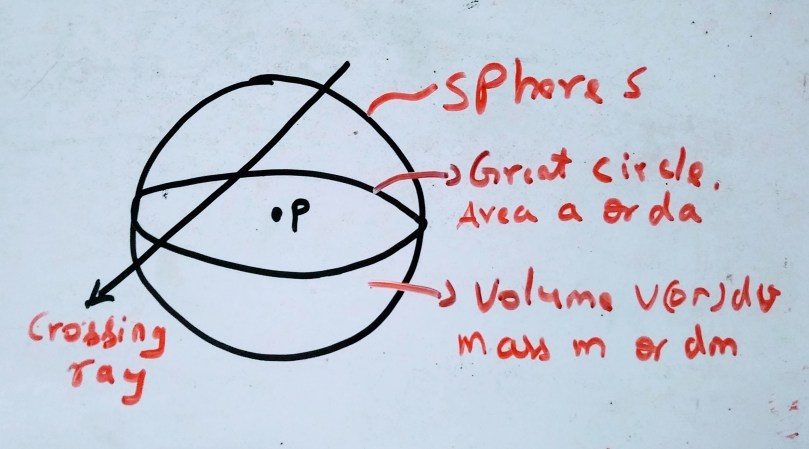
We know from the characteristics of the stochastic quantity, we need to consider a finite domain. In this case we consider a sphere because it has same cross sectional area for rays entering from any direction. Let us consider the specific energy(z), which is the quotient of energy imparted ε to the mass m, the repeated measurements will give the probability distribution of z and its mean z̄ and as the mass becomes infinitesimal dm as mentioned above in the illustration the mean z̄ approaches to absorbed dose D. (the distribution of z is actually not necessary for the measurement of D)

for example in case of biological cell it deals with micro dosimetry, where the knowledge of distribution z corresponding to a know D is important in the irradiated mass m, as the effect of radiation is more closely related to z than D. The values of z greatly differ from D for a small m

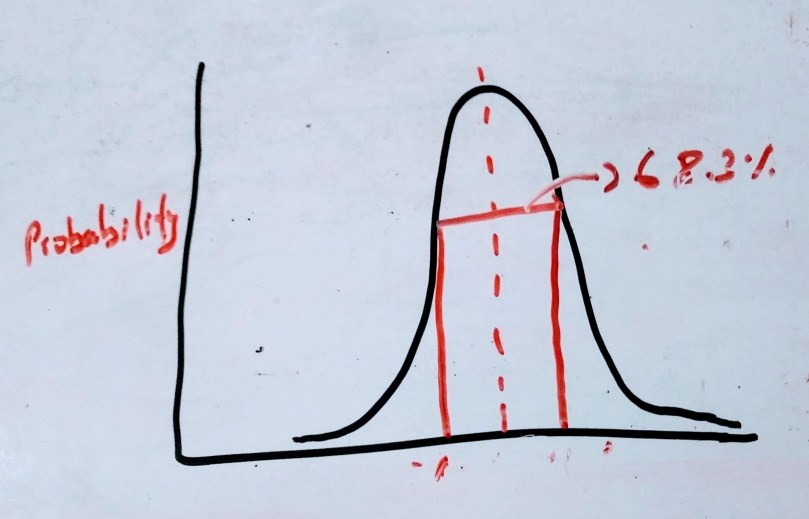
If we assume the radiation field is strictly random, as shown from above illustration the rays reaching the given point per unit area and time interval will follow Poisson distribution, for large number of events it may be approximated to Gaussian distribution

The standard deviation of single random measurement N relative to Ne is equal to σ = \sqrt{N_e} \cong \sqrt{N} and the corresponding percentage deviation is S = \frac{100}{\sqrt{N}} the single random measurement will have probability of true value falling within the uncertainty range is 68.3%
References

How is it possible for photons to transfer energy when it has no mass !

E = mc2 is the special case of E2 = ρ2c2 + m2c4 , Its a combination of mass energy and momentum energy. The mass of photon is 0, so they get all their energy from momentum, Energy of photon reduces to E = ρc . e.g. A rope connected to an object in one end, when other end of the rope is shook violently it can move/jerk the object in other end i.e. the rope did not carry any mass but transferred energy in the form of wave motion. The same way the photons transfer energy.

Why Co-60 machine has 80cm SAD?

The reasons are Geometric penumbra and Source Strength

Geometric penumbra

  • It is due to the finite size of the source

The width of the geometric penumbra (Pd) at any depth (d) from the surface of the patient is given by

  • s is the source size
  • SSD is Source to Surface Distance 
  • SDD is Source to Diaphragm Distance

Source Size is varied while SSD and SDD are kept constant

From the above image its clear that as source size increases the Geometric Penumbra increases
In case of cobalt 60 the source size are between 1.5 cm diameter to 2 cm diameter

SDD is Varied

As the SDD increases the geometric penumbra decreases, but as the diaphragm gets near the skin the scattered radiation from the diaphragm results in more skin dose, hence there must be at-least 15 cm gap between skin and diaphragm.

As the SSD increases,due to the effect of inverse square law the geometric penumbra increases.

Source Strength

The Source strength influences the dose rate, the Dose date decreases as the SSD increases due to inverse square law effect

As the PDD determines how much dose can be delivered relative to Dmax, the SSD need to be as large as possible, but as mentioned earlier the dose rate decreases due to distance.

Considering all this factors the SAD is kept at an optimal distance of 80 cm.

In new machine100 cm SSD is available due to more specific activity of source, without changing the source size, it is possible to go for higher SSD not by changing the geometric penumbra.

why temperature and pressure correction factor used while calculating dose using ion chambers?

The ion chambers used in measuring the adsorbed dose are generally vented ion chambers. Thus the mass of the air  inside the sensitive volume of the chamber varies with respect to the density(𝝆) and volume(V) i.e. m = 𝝆V,  As the volume of the chamber remains constant, the density varies with respect to pressure and temperature

As the pressure increases the density increases(i.e.more air molecules) {Boyel’s law} , hence more interaction occurs. This results in more number of charge collection. The dose measured in this case is overestimated from that measured in standard condition

If the temperature increases the density decreases{Charle’s Law}. In this case, the number of interactions are less and the dose measured is under estimated from the measured dose under standard conditions.

To compensate this , the temperature-pressure correction factor(KTP) was introduced

Po and To are reference values of pressure(KPa) and temperature(℃) according to SSDL. P and T are air pressure and temperature at the time of measurement

The dosimeters what we use in clinics are relative dosimeters, i.e. they are calibrated under laboratory conditions. These laboratory conditions may change between SSDL’s, one might have did the calibration with temperature as 20 ℃  and other might have done with 21℃ , so always its a best practice to refer calibration certificate for reference temperature and pressure.