The density of ionization in particle track is described by the term Linear Energy Transfer (LET). In other words, it is the measure of number of ions produced per unit path length of the track.
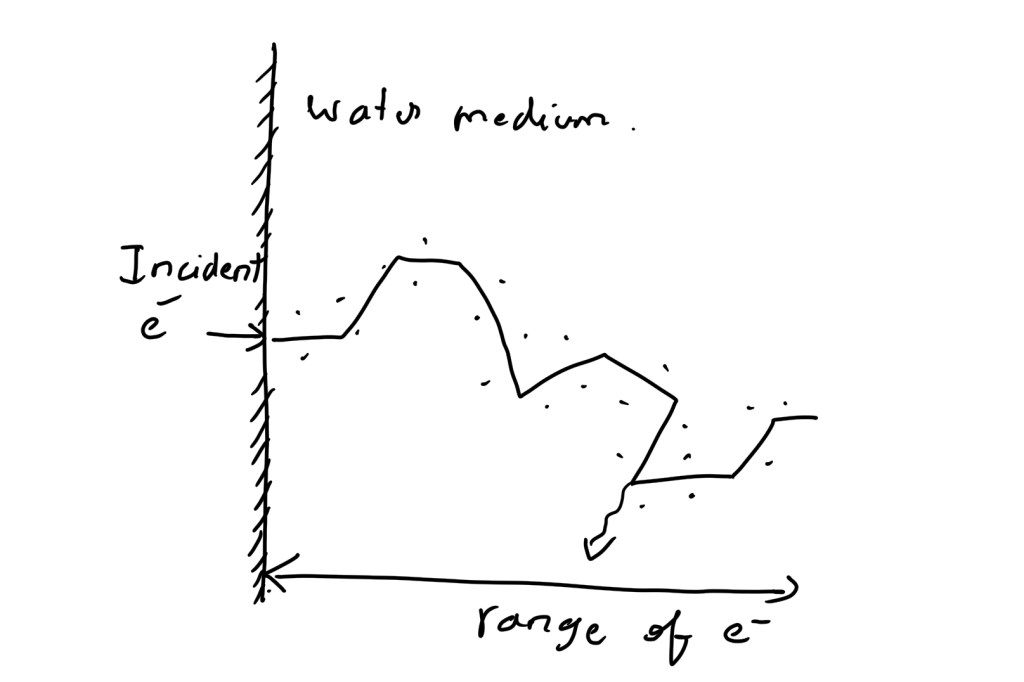
What is difference between path length and range?
The thickness of medium required for entire energy of the particle to be absorbed is called range
The entire zig-zag distance travelled is called path length
Is = Sc/W
Where,
Is is linear density of Ionization.
Sc is unrestricted collision stopping power
W is avg. energy expended per ionization event.
Not all energy accounted for for stopping power Sc results in ionization along the primary track. Instead some secondary electrons will have energy to travel farther away from primary track and deposit the energy. LET Δ is defined to distinguish the ionization event occurring along the primary track from the ionization occurring due to secondary electrons farther away from primary track. The smaller the size of specific energy Δ the stricter the determination of LET Δ with respect to ionization along primary track. The higher the Δ value the LET Δ equals to Sc, which is represented as LET ∞ (upper limit of LET).
LET is the average energy per unit distance deposited by charged particle.
Unit KeV /µm
Why LET is an average quantity?
At microscopic level the energy per unit length of track varies drastically.
(one of the complication, If the range of energy variation is too large then the average quantity itself becomes meaning less)
The definition says charged particle, but neutrons are not charged particles? How do we consider them as high- LET radiation?
The charged particles undergoes ionization by interacting with orbital electrons. In case of neutron when they pass through the tissue they do not directly produce ionization. Instead it reacts with the atomic nuclei and eject densely ionizing protons and other particles The ionization due these secondary particles results in high-LET
Different ways to calculate the average?
1] Track Average
2] Energy Average
Track Average – It is obtained by dividing the tracks into equal lengths and calculating the energy deposited in each length. It is most commonly used method
Energy Average – It is obtained by dividing the track into equal energy
intervals and averaging the lengths of the track.
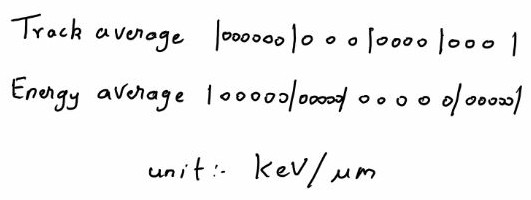
The track average and energy average is almost same for X-rays and mono energetic charged particle. In case of neutron both average shows large variation between them. The biological effects more correlated towards energy average in case of neutron.
e.g. 14 MeV neutron’s – LET track average 12 KeV /µm and energy average 100 KeV /µm
Linear Energy Transfer Values
| Radiation Type | LET in KeV /µm |
| Cobalt – 60 γ rays | 0.2 |
| 250 KV X-rays | 2.0 |
| 10 MeV Protons | 4.7 |
| 150 MeV Protons | 0.5 |
| 14 MeV Neutrons | Track Average 12 Energy average 100 |
| 2.5 MeV α particle | 166 |
It can be simply used to indicate the quality of radiation type(radiobiologically). It is also noted that due to above seen complication such as difference between different averaging methods and range of the average, LET may be misleading in some circumstances.
Reference
1) Hall, Eric J., and Amato J. Giaccia. Radiobiology for the Radiologist. Vol. 6. 2006.
2) Joiner, Michael C., and Albert Van der Kogel. Basic clinical radiobiology fourth edition. CRC press, 2009.
3) Jayaraman, Subramania, and Lawrence H. Lanzl. Clinical radiotherapy physics. Springer Science & Business Media, 2011.
 0.05 can be considered as 0
 Medical Physics Blog